AI Search & SEO
Services
Quick Answer: AI search and SEO services optimize your website to rank on Google and to get cited by AI answer engines like ChatGPT, Perplexity, Gemini, and Google AI Overviews, using technical SEO, structured data, and content written in a format both search engines and AI systems can understand.
Built to Get Found on Google and in AI Answers
Search has split into two tracks. Google's traditional results still matter, but a growing share of questions now get answered directly inside AI Overviews, ChatGPT, Perplexity, and Gemini, without the person ever clicking through to a website.
As an AI search and SEO agency, Marketing Rockers optimizes for both tracks at once: the technical and content fundamentals that rank you on Google, plus the structure, clarity, and entity signals that get you cited inside AI-generated answers.
If your competitors are already showing up when someone asks ChatGPT or Google AI Overviews a question in your category and you aren't, that's a visibility gap this is built to close.
Get Your Free AI Search Visibility Audit
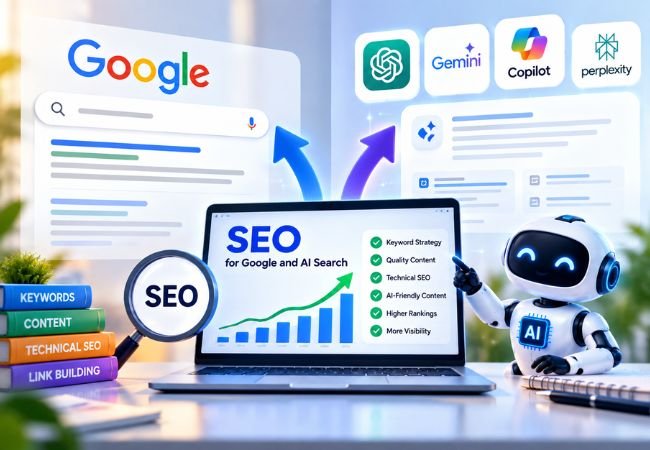
How Is SEO Different for Google vs AI Search?
Google SEO still rewards technical health, backlinks, and relevant content, and ranks a list of pages the person chooses from. AI search works differently: an AI system reads across multiple sources, picks out the clearest and most specific answer, and presents it directly, often citing only one or two sources.
That means content written to rank well on Google isn't automatically content that gets picked up by AI systems. AI search rewards clear, direct answers near the top of a page, well-structured headings, and content that unambiguously states what something is, how it works, and who it's for, exactly the things a person skimming would also want.
Our approach treats these as one connected strategy rather than two separate services, since the technical and content foundations largely overlap.
Why Most Websites Miss AI Search Visibility
The same gaps keep well-ranked websites invisible to AI answer engines.
No Direct Answers
Content buries the answer three paragraphs deep instead of stating it clearly near the top, so AI systems have nothing clean to cite.
Weak Structured Data
Missing or incomplete schema markup means search engines and AI crawlers can't confidently understand what a page is about.
Unclear Entity Signals
A site that never clearly states what it is, does, and serves gives AI systems little to work with when deciding whether to cite it.
Content Written Only for Keywords
Pages stuffed with keywords but light on real substance rank poorly with both Google's helpful content systems and AI answer engines.
No Topical Depth
A handful of disconnected pages, instead of a connected cluster of content, signals shallow authority on a topic.
Outdated Technical SEO
Slow pages, broken crawlability, or thin mobile experiences hold back visibility regardless of how good the content is.
What's Included in Our AI Search & SEO System
Technical SEO, content, and structured data working together for both Google and AI search.
Our AI Search SEO Process
Reviewed monthly, since AI models and Google's algorithms both keep changing.
Audit current visibility across Google and AI answer engines like ChatGPT, Perplexity, Gemini, and AI Overviews.
Fix technical SEO foundations, schema markup, crawlability, site speed, and mobile experience.
Build topic clusters and strengthen entity signals around your core services.
Rewrite or restructure content in answer-first format with Quick Answer sections.
Add structured data so search engines and AI systems can parse your content accurately.
Publish new AI-ready content targeting both traditional rankings and AI Overviews.
Monitor citations and visibility across AI search platforms.
Review and refine monthly as algorithms and AI models change.
Traditional SEO vs AI Search Optimization (GEO)
| Parameter | Traditional SEO | AI Search Optimization |
|---|---|---|
| Goal | Rank in Google's list of results | Get cited directly inside AI-generated answers |
| Content format | Long-form pages optimized for keywords | Answer-first structure with clear, direct statements |
| Structured data | Often minimal or generic | Detailed schema so AI systems can parse content confidently |
| Success signal | Rankings and click-through rate | Citations inside AI Overviews, ChatGPT, and similar tools |
| Topical approach | Individual pages targeting keywords | Connected topic clusters that build entity authority |
Who Needs AI Search Optimization?
This matters for any business whose customers research online before buying, including:
- CA firms and tax consultants answering common compliance questions
- Law firms whose prospects research legal questions before calling
- Travel and cab service businesses competing on local search visibility
- SaaS platforms being compared and researched through AI tools
- E-commerce brands whose products get researched before purchase
- PR and marketing agencies managing search visibility for multiple clients
If your competitors are already showing up when someone asks Google AI Overviews or ChatGPT a question in your category and you aren't, this is built to close that gap.

Get Found in Search & AI
Search isn't just ten blue links anymore. If your business isn't optimized for AI Overviews, ChatGPT, and Perplexity as well as Google, you're invisible for a growing share of the questions your customers are asking.
Contact us at +91-9355700651 or email us at info@marketingrockers.in
Book a Free AI Search Visibility Audit