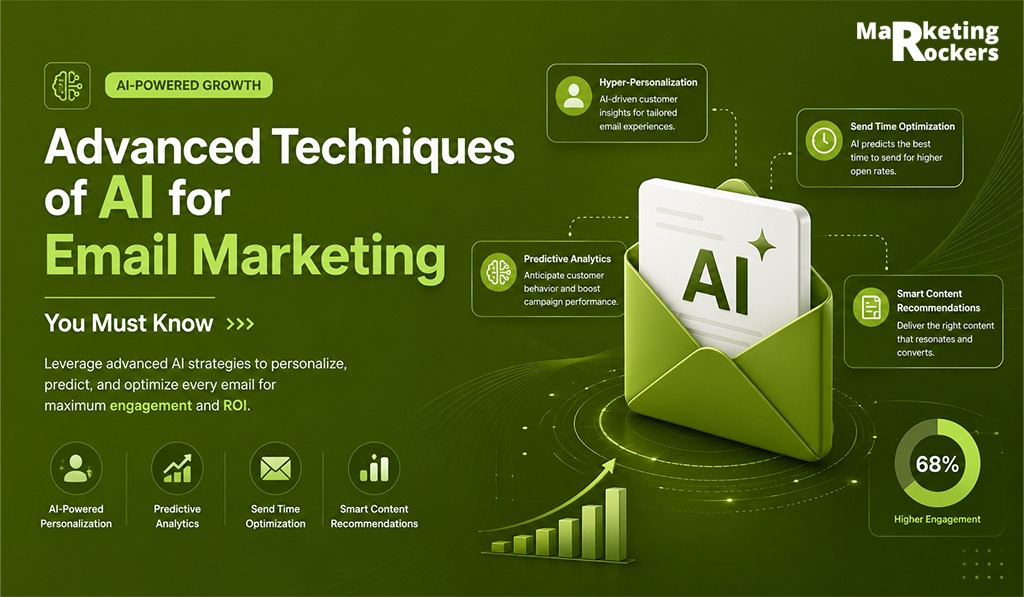
Email is not going anywhere. There are 4.55 billion email users globally, and 99% of them check their inbox every single day. And yet, the average campaign is getting harder to cut through. Inboxes are noisier, subscribers are quicker to disengage, and sending more emails is no longer the answer.
What is the answer? AI for email marketing—not as a buzzword, but as a genuine shift in how the smartest campaigns are being built and run in 2026.
Email marketing delivers an average return of $36–42 for every dollar spent in 2026, outperforming paid search, social advertising, and display ads. The brands hitting those numbers are not sending more. They are sending smarter. Here is how.
1. Stop Segmenting by the Past—Start Predicting the Future
Most teams still segment by what subscribers have already done: opened last month, clicked once, or purchased before. That is backward-looking, and in 2026 it is not enough.
Segmented campaigns generate 760% more revenue than non-segmented broadcasts. The most effective segmentation now combines behavioral data with AI-predicted intent scores—and hyper-segmented campaigns targeting micro-audiences of 500–2,000 contacts outperform broad segments by 3.4x on conversion rate.
Klaviyo does predictive segmentation better than almost anyone. Its K:AI system scores each subscriber on purchase likelihood, churn risk, and predicted lifetime value—all updating in real time as new data comes in. For product and e-commerce brands, this is where the revenue gap opens up. Free plan available. Paid from $20/month.
2. Individual Send-Time Optimization—Not Tuesday at 10am
Predictive AI can make a measurable difference: campaigns using AI-driven audience targeting see click rates of 2.8% versus 1.4% for manual segmentation—essentially double. A big part of that is when the email lands, not just who it goes to.
ActiveCampaign analyses each contact’s individual historical engagement and predicts the best send window per person—not per campaign. For B2B teams running nurture sequences across longer sales cycles, this level of granularity in email marketing AI tools is what moves reply rates. From $15/month.
3. AI-Expanded Behavioral Triggers
This is where AI for email marketing starts doing things rule-based automation simply cannot. Welcome emails and abandoned cart reminders are table stakes. The advanced layer in 2026 is AI-triggered sequences that respond to signals most marketers are not even tracking yet—price sensitivity, browse patterns, replenishment cycles, and early churn signals detected before a subscriber has even thought about leaving.
HubSpot’s Breeze Intelligence connects these triggers directly to CRM data. If a lead’s deal stage changes in the pipeline, the email sequence adapts automatically. That connection between sales activity and email behaviour is what most AI tools for email marketing miss entirely. Free CRM. Marketing Hub from $20/month.
4. Subject Lines That Actually Get Opened
AI-generated subject lines outperform human-written ones by 26% on open rates. This is one of the fastest wins you can get from AI for email marketing, and it requires almost no change to your existing workflow. That advantage compounds with dynamic send-time optimization, which adds another 14% lift when the two are used together.
The specialist tools here are Phrasee and Persado; both use NLP models trained specifically on email performance data to generate and test subject lines at scale. They do not just suggest options; they learn from every campaign and refine their outputs over time. Used by enterprise brands for exactly this reason. Custom pricing based on volume.
For smaller teams, Mailchimp’s AI Content Optimiser analyses drafts against industry benchmarks and suggests subject line improvements, send times, and content length adjustments. Not as deep as Phrasee, but accessible and already built into a platform most people are using. Free plan. Paid from $13/month.
5. Interactive Emails—The Inbox Experience Nobody Expects
This is the most underused technique in AI email marketing software right now. Mailmodo uses AMP email technology to embed forms, polls, quizzes, and booking tools directly inside the email—so subscribers take action without ever leaving their inbox.
Interactive AMP emails see 520% higher engagement than static emails. Mailmodo automatically serves a plain HTML fallback for email clients that do not support AMP, so deliverability is not compromised. For B2B teams running lead qualification or event campaigns, this is a genuine differentiator that most competitors have not caught up on. Free plan. Paid from $49/month.
6. Deliverability Is Strategy—Not a Technical Afterthought
None of the above matters if your email does not reach the inbox. Getting deliverability right is what makes every other AI for email marketing technique actually land where it is supposed to. Senders without proper SPF, DKIM, and DMARC records see inbox placement rates drop to 44%, compared to 89% for fully authenticated domains.
Brevo (formerly Sendinblue) includes built-in deliverability monitoring, sender reputation tracking, and AI-driven list hygiene that flags disengaged contacts before they start hurting your sending score. For teams scaling email lists quickly—especially in India, where list quality varies significantly—this layer is what keeps everything else working. Free plan. Paid from $9/month.
Quick Comparison
| Tool | Best For | Price From |
|---|---|---|
| Klaviyo | Predictive segmentation, e-commerce | Free / $20 pm |
| ActiveCampaign | Individual send time, B2B nurture | $15/month |
| HubSpot | CRM-connected triggers | Free CRM |
| Mailmodo | Interactive AMP emails | Free / $49 pm |
| Mailchimp | Subject line and content optimization | Free / $13 pm |
| Phrasee / Persado | Enterprise-level copy and subject lines | Custom |
| Brevo | Deliverability and list hygiene | Free / $9 pm |
The Technique Most People Miss
Most strategy guides give you a flat list of things to do. A real 2026 email strategy has three layers that build on each other: foundation (deliverability, authentication, list quality), system (lifecycle automations, segmentation, owned data), and optimization (AI-assisted analysis, testing, content quality). Work in that order.
Email marketing with AI compounds when it runs across all three layers—not just the top one. Most teams jump straight to subject line testing while their DMARC is misconfigured. Fix the foundation first.
Why Choose Marketing Rockers?
Strong email marketing needs strong traffic behind it—the right people finding your brand through search, paid ads, and social media before they ever join your list. At Marketing Rockers, we build the digital presence that makes every channel perform better. SEO, Google Ads, social media, and content strategy that drives qualified audiences to your brand—so when they do reach your email list, they are already warm.
If you want a digital marketing setup where every channel supports the next, come talk to us.
📞 +91-9355700651 | 📧 info@marketingrockers.in
FAQs
Q: How do I know if my email list is ready for AI personalization?
If you have basic subscriber data—name, sign-up source, and a few months of open/click history—you have enough to start. AI tools build on whatever data you have and improve as more comes in.
Q: Is AI email marketing only for large businesses?
Not at all. Mailchimp, Brevo, and Klaviyo all have free or low-cost plans with meaningful AI features. The tools have scaled down significantly in price over the last two years.
Q: Will AI-generated emails feel impersonal to subscribers?
Only if you use them without editing. AI handles the structure and optimization; the brand voice and human judgment should still come from your team before anything goes out.
Q: What is the difference between automation and AI in email marketing?
Automation follows fixed rules. AI learns from behavior and adapts in real time—changing what to send, when, and to whom based on continuously updated predictions.
Q: How important is email authentication in 2026?
Very. Google, Yahoo, and major inbox providers have made SPF, DKIM, and DMARC the essential identity layer for bulk email senders—and inbox placement now depends as much on technical trust signals as on engagement. Without proper authentication, even the best-written AI campaigns may never reach the inbox.